Restart Tourism with Automation

Automating guest communication? Chatbots are just the tip of the iceberg

Zoe Koumbouzi

In times of crises, we tend to look to technology to increase efficiency and reduce costs. Previous crises have boosted digital transformation and the current corona pandemic is no different. Digital transformation means replacing existing practices with more advanced digital technology to become more efficient. It can involve many technologies, but currently, Artificial Intelligence and big data are driving much of the transformation.

It has been shown that companies that adopt quickly and decisively in times of crises to new paradigms, later reap the rewards. It’s not the moment to play it safe, on the contrary: now is the time to reassess your digital tech stack. Once we reach the post-pandemic era, newly implemented technologies will become the new norm. Taking an early digital leap will set your property ahead of your competitors when things take off again.

What technologies should I consider?

Let chatbots do the chatting

Artificial intelligence has been named as the most promising technology of the past few years. It’s clear that we will see a rapid increase in the use of AI in all sorts of platforms, messaging being no exception. AI-driven chatbots are a great tool to streamline guest communications, whether before, during or after their stay.

During the pandemic, we have acquired new digital habits, most of which include our mobile phones, like scanning QR codes for restaurant menus, video calling, not to mention a huge global uptake in messaging use. The post-pandemic guest will expect to be able to request services or ask questions through their usual messaging channels instead of having to queue at reception.

Automate and streamline workflows

Chatbots are a great way to start the digitalization of your guest communication. However, it is important that the processes that follow or precede the conversation are equally digitalized and streamlined. When a guest requests come in through your messaging platform, the right automated processes should be in place, so the requests immediately land into the right hands and it’s clearly understood what the next steps are.

Don’t wait, automate

Consider automating your reactive (incoming) but also your proactive (outgoing) communication. Send out the key information before arrival, so your guest can come prepared with the right expectations, and you can be well prepared for your guest. By proactively contacting your guests at key stages of their guest journey, you can detect any needs before they become issues and facilitate essential information.

Collect, analyze & learn from guest data

In this changing landscape it can be hard to pinpoint guest needs, which is where guest analytics can help you. To understand your new type of guests, analyze guest data by gathering information through messaging interactions and guest requests. Collect all your interactions and stays into one profile to better understand who your guests are and create smart guest lists for a more effective and segmented communication.

Learn about your guests’ needs and preferences by analyzing your incoming guest requests: what services or information do they request most, through what messaging channels, etc. Guest request data can also help you improve and streamline your operations by looking at what issues are reported most frequently, what are the root causes, are all issues resolved, how fast are they resolved, etc. Keeping track of guest data will allow you to adapt and better your strategies as the situation continues to evolve.

When you decide to introduce a chatbot into your organisation, keep in mind that for a successful digital communication strategy you need much more. They are a great starting point, but the rest of your operations should also be optimised and streamlined with the right technologies so you are well-prepared for what comes after the pandemic.

Tags: chatbotsdigital transformationtechnology

About the Author:

Zoe Koumbouzi

ReviewPro is the world leader of Guest Intelligence solutions, with more than 60,000 hotels in 150 countries. ReviewPro’s Global Review Index™ (GRI), the industry-standard online reputation score, is based on review data collected from 175+ OTAs and review sites in 45+ languages. The company’s cloud-based Guest Experience Improvement Suite includes Online Reputation Management, Guest Satisfaction Surveys, and Auto Case Management. ReviewPro also provides an AI-driven innovative Guest Experience Automation™ product to automate guest experience management for hotels. These tools and processes enable clients to prioritize operational and service improvements to deliver better guest experiences and increase guest satisfaction, online rankings, and revenue.

Source: https://insights.ehotelier.com/insights/2020/11/13/automating-guest-communication-chatbots-are-just-the-tip-of-the-iceberg/?utm_source=Newsletter&utm_campaign=1927f80f04-Daily_Newsletter&utm_medium=email&utm_term=0_e17a7bf7c4-1927f80f04-327206962&goal=0_e17a7bf7c4-1927f80f04-327206962&mc_cid=1927f80f04&mc_eid=fc1a397e4d

Listening to Residents: Participatory Planning

Can citizens design their own streets?

Jaime Ramos

The fully realized smart city ideal offers a tool that goes beyond the advanced use of technology to improve the life of its citizens: the capacity to enable citizens to have a say not just in matters related to public affairs, but the city’s own urban organization.

The future of urban planning

One of the finest examples of this democratic instrument is the possibility of being involved in the urban planning process. A process which, traditionally, has not included the average citizen. Neighborhood associations and related groups have fought in recent years for the voices of the people to be heard.

Despite this and the fact that regulations now establish some formulas for engagement (such as social councils in cities), local authorities have the last word in terms of urban design and street furniture. Smart cities aims to overthrow this model. In terms of urban design, the future of urban planning goes beyond simply listening to citizens, to actually place them at the center of all strategies.

Setting an example in participative urban planning

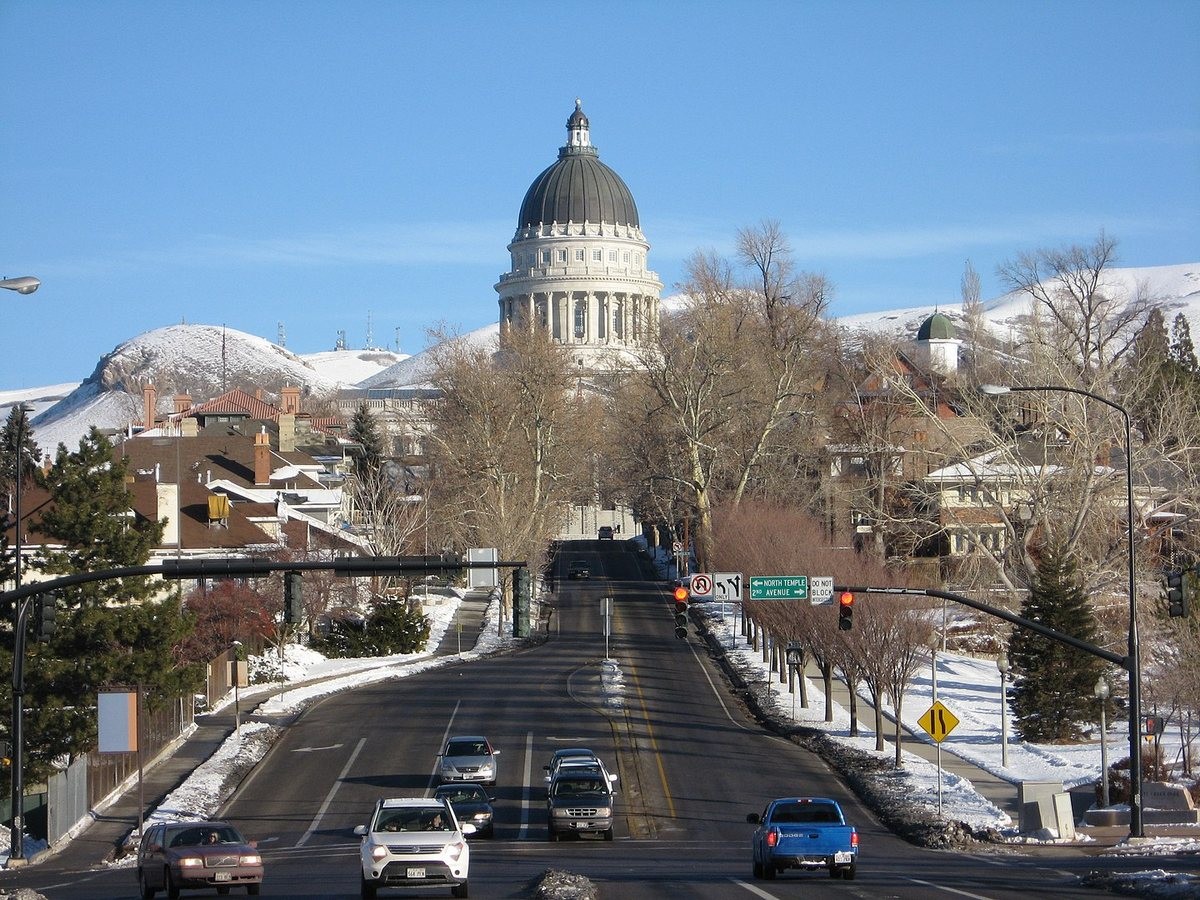
Aerial view of Salt Lake City

The capital of the state of Utah, Salt Lake City, has around 200,000 inhabitants in its historic center and it seeks to establish a precedent in the area of smart urban planning. In fact, the project has begun by revolutionizing the classic street typologies applied in this area. Until now, there were three types of roads in the United States:

  • Arterial.
  • Collectors or distributors.
  • Local.

This model shared by many major cities, is based on facilitating the flow of traffic in the city. The system is also responsible for the Cartesian layouts that exist in so many major cities across the country. Now, well into the 21st century, the aim is to steal the leading role away from cars.

Salt Lake City’s smart urban planning project

Salt lake city downtown

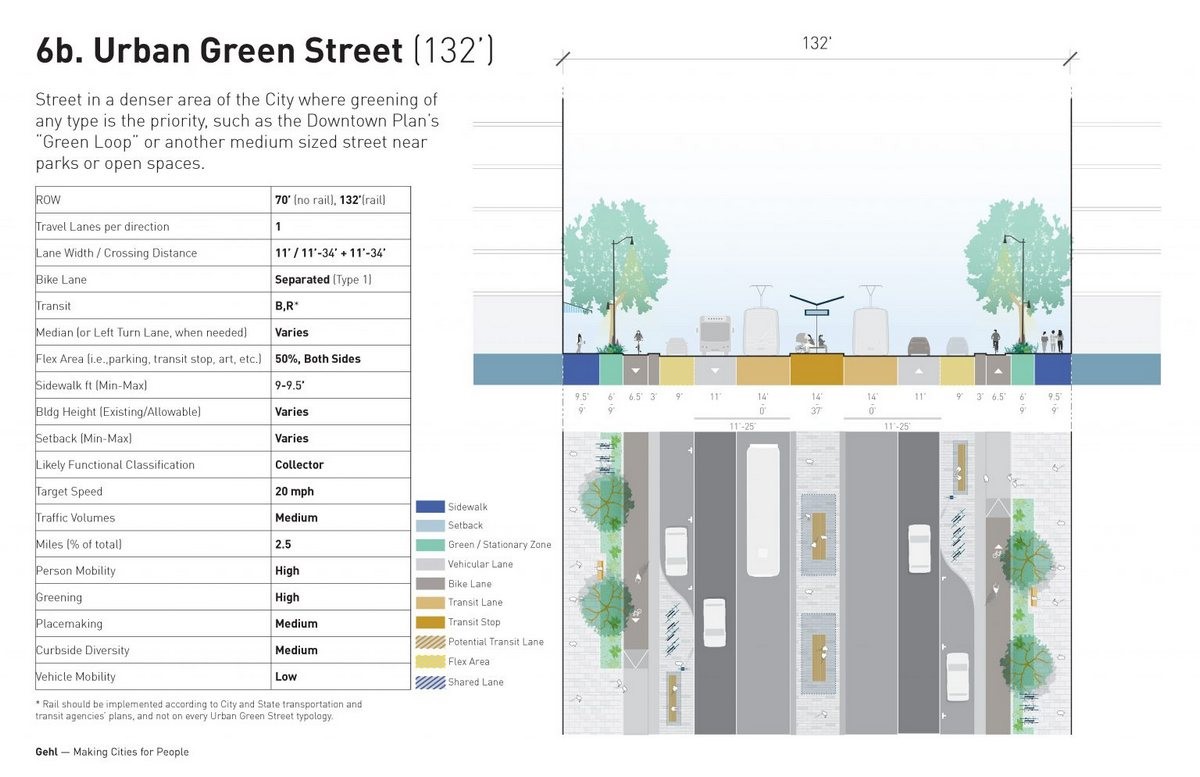
Citizens have a real say in this task. Salt Lake City launched a survey last Autumn, which defined up to 15 types of roads, based on the different urban functionalities. This not only enables greater engagement, but also opens the door to customized urban planning designs.

The new typologies are applied to over 8,400 roads in the center and they are included in a guide with real models made public by the authorities. To create these, five factors regarding public use spaces were taken into account:

  • Personal mobility, in terms of pedestrians, bikes and PMVs.
  • Mobility of other vehicles.
  • The environment (greening), relating to minimum sustainability requirements and green spaces.
  • That is, the concept of a street as a social activity and not just as a walking exercise.
  • Use of sidewalks.

Citizen contributions

Urban planning guide

In a subsequent chapter, the citizens of Salt Lake City have finalized the 15 types of streets and, in general, the guide, providing more feedback through the enabled web platform. In order to make it more accessible, it offers a map, which distinguishes the type of streets according to a color code and in which comments can be added to each street. This way, urban planners gain valuable insights about its given or expected usage well before construction machinery starts rolling.

After this phase, the authorities will draw up a final draft of the guide, the standards of which will be used by urban planners when the city’s next map is designed.

Towards a more humane and inclusive urban planning

Citizen participation in matters of urban planning can push towards the development of streets and blocks far more accessible, taking into account both large collectives and also minorities, empowering stakeholders at all levels and reducing the dependence on simple statistics that may distort the full picture. These measures can be complemented with innovative projects such as Block by block, which allows citizens to create a basic digital twin using the popular videogame Minecraft.

The basic needs of each city can drastically differ due to their soecieties, economies and preexisting circumstances. All in all, the most common reactions of the Salt Lake City inhabitants tend to demand more public space for people and less for vehicles.

Images | Yhz1221 (CC BY-SA 3.0), Matt MiltonPadraic Ryan (CC BY-SA 3.0), Street & Intersection Typologies Design Guide 

26 AUGUST 2020 

Source: https://www.smartcitylab.com/blog/urban-environment/could-citizens-plan-their-own-streets/

Enhancing the artistic and heritage landscape experience with Virtual Reality

V&A Collaborates with HTC for Alice in Wonderland VR Experience

Richard Whiddington

September 30, 2020

photo

The London institution’s major 2021 exhibition will use virtual reality to bring the cultural legacy of Lewis Caroll’s fantasy classic to life. Image: VIVE Arts

In the internet age, down the rabbit hole is an expression largely divorced from its literary origins. Instead, it has come to connote the habit of burrowing ever deeper through cyberspace, an experience familiar to many after months of increased reliance on digital connectivity. Fittingly, London’s Victoria & Albert Museum is pairing old and new by using virtual reality (VR) to complement its upcoming exhibition “Alice: Curiouser and Curiouser”, an exploratory ode to Lewis Carroll’s classic novel.

Originally planned as the museum’s blockbuster exhibition for summer 2020, it’s added to displaying the Royal Ballet’s extravagant sets and costumes from “The Red Queen” and Ralph Steadman’s iconic illustrations by partnering with HTC Vive Arts and Preloaded, an immersive games studio, to create an accompanying VR experience that will be available to visitors when it opens in late March 2021. https://www.youtube.com/embed/71zOPvcqU3s?start=1&feature=oembed

VR is a medium ideally suited for Alice and Wonderland’s psychedelic and kaleidoscope worlds which has captivated audiences since it was published a century and a half ago. Through integrating artwork by Icelandic illustrator Kristjana S Williams, the VR experience situates fantastical elements of Caroll’s novel — giant butterflies, flamingos, and, yes, rabbit holes — within digital recreations of the physical museum.

Beyond exploring immersive worlds, users are invited to complete challenges such as solving caterpillar riddles and playing a game of croquet with the Queen of Hearts. It’s the first time the V&A has used VR for an event and continues the museum’s reputation for integrating the latest technologies in large-scale exhibitions.

On October 22, audiences from around the world will be able to experience this special event either through a VR headset or a Windows PC (in 2D). Image: VIVE Arts

Live VR preview

In anticipation of “Alice: Curiouser and Curiouser”, the V&A is hosting an immersive VR event on Oct 22. Free to attend, participants can join as avatars and follow curator Kate Bailey as she leads the audience through the exhibition’s five sections. Crucially, audiences will be able to participate with or without a VR headset and can watch live via the V&A’s YouTube page.

In the V&A’s words

Since their creation, the Alice books, with their mind-blowing ideas and concepts, have been a source of inspiration for new technologies from silent film to CGI. It has been an extraordinary adventure to work with HTC Vive Arts and Preloaded to take our exhibition into a playful new dimension of VR.

Kate Bailey, Curator of “Alice: Curiouser and Curiouser”

The VR experience created by the V&A and HTC Vive Arts features original artwork by Kristjana S Williams. Image: V&A

In VIVE Arts words

The unprecedented circumstances in 2020 have demonstrated how technology can inspire and connect us, and we are proud to support the V&A, and to help further its mission to broaden access to the museum, using bold new models to transform how art and culture is experienced.

Victoria Chang, Director of VIVE Arts at HTC

In 2019, Musee du Louvre presented its first VR experience, Mona Lisa: Beyond the Glass, with HTC VIVE Arts to commemorate the 500th anniversary of da Vinci’s death in France. Image: VIVE Arts

Source: https://jingtravel.com/va-collaborates-with-htc-for-alice-in-wonderland-vr-experience/?utm_source=Jing+Travel&utm_campaign=63a5db4a75-EMAIL_CAMPAIGN_8_3_2020_13_13_COPY_01&utm_medium=email&utm_term=0_5fb5a8e57f-63a5db4a75-42594123

Technology to Restart Tourism

Hotel Contactless Tech: What Will Stick and What Won’t?

By Wouter Geerts, Skift- Sep 25, 2020 10:00 am

Contactless technology is being adopted in hotels at breakneck speed to ensure safe operations. Not all tech is created equal though. Skift Research looked at what tech has the momentum to continue growing after the pandemic fades.— Wouter GeertsSHARETweetSharePostSend

Contactless interactions have become crucial to the successful operation of a hotel during these times of crisis. Surveys are showing that guests want it, and hoteliers realize it. The result is a major jump in the uptake of contactless technology.

That said, not all technology is created equal, and that also goes for the various contactless tech solutions. Some tools have seen strong uptake in the past months, but might fade as the virus (hopefully) fades in the coming years. Other tech will continue to define how hotel guests interact with hoteliers for years to come.

More: Contactless Tech in Hospitality 2020

CONTACTLESS TECH WILL BE LESS IMPORTANT THAN IT SEEMS NOW

This is a big headline to kick things off with. To clarify, it is clear that almost every hotel will eventually adopt some or all of the contactless technologies set out [in the report]. This is clearly a growth area with a lot of room to grow.

We believe, however, that surveys or success cases stating the importance of these technologies to guests should be read with a pinch of salt. Not only will the importance of contactless interactions undoubtedly diminish over the coming years, guests generally overstate the importance of hotel features when asked.

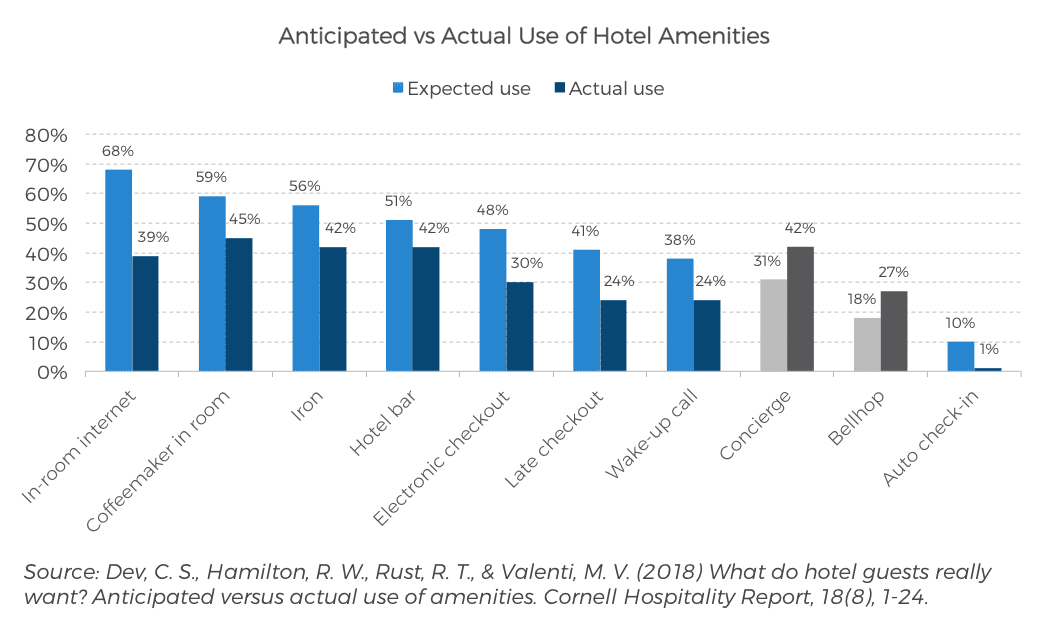
A case in point is a 2018 research paper published in the Cornell Hospitality Report, which shows that the vast majority of guests ‘overpredict’ what hotel amenities they will actually use. The authors surveyed 724 hotel guests staying in 33 different U.S. based hotels, questioning them before their stay about their anticipated use of hotel amenities, and then again afterwards about their actual use of amenities. Below we have visualized a selection of the findings.

Most hotel amenities are used less than expected by guests

The results show that we should be careful when assuming that the uptake of these new contactless technologies will be universal, even when guests say they want them in surveys. And when we consider the presence of these technologies as a determining factor in booking a hotel, their impact is likely to be even lower.

Of course, anticipating that there is free WiFi, or a seamless check-in process, could certainly impact booking behavior, but countless studies have found that price, location, and possibly brand, always trump any other factors. And considering the race is on for most hotels to implement these systems, the competitive advantage for hotels with contactless tech will soon be lost.

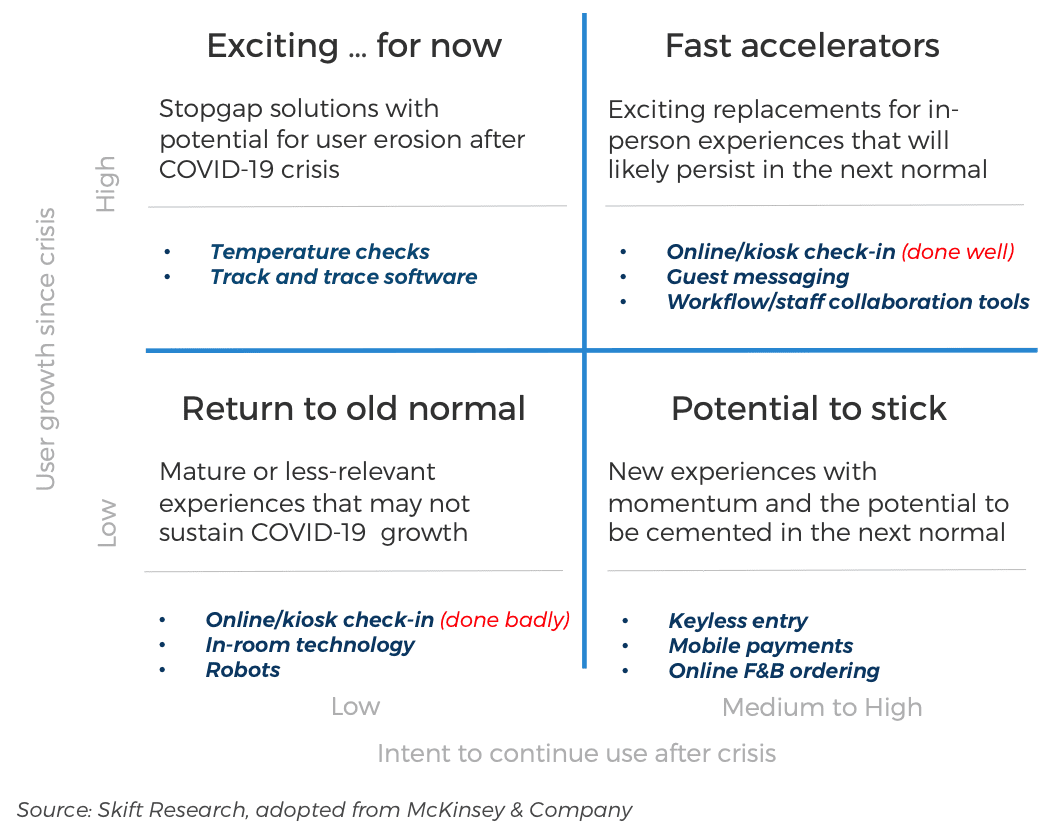
McKinsey introduced an interesting framework in a recent article to evaluate which COVID induced consumer trends and behaviors — and which technologies as an extension of that — will be here to stay, and which will likely fade. We can apply this to contactless technologies in the hotel space. Below is our view, but with the ever-changing situation this is very much an opinionated stance. Everyone should determine for themselves how they see different technologies evolve, and make decisions based on that.

Evaluating the future potential of contactless technologies


Tags: contactlesshotel techhotel tech stackkeyless entrymessagingtouchless

Source: https://skift.com/2020/09/25/hotel-contactless-tech-what-will-stick-and-what-wont/

Expect More Personalized Service

The buffet is gone and a la carte is back – a positive Coronavirus effect

29/09/2020

Stephan BuschInsights

Buffets are banned because Coronavirus doesn’t allow us to breath, sneeze and cough all together at a buffet table. Fair enough, we have to live with that. What alternative do we have? A la carte – and that is good! Nevertheless, there were many advantages to a buffet… but we shouldn’t be too sad that it has disappeared (maybe only for a while).

The advantages a buffet had (if done right)

  • It was a great display and eye catcher – Food was the one, big, magnificent ingredient, but wonderful buffet design, flowers, expensive and unique equipment could made it a great attraction. When live cooking stations were included, it could be a lively place and an attractive display that people rightfully enjoyed.
  • A buffet showed you honestly what you will get – Compared with a menu where you hope for the best outcome of the dishes as described, a buffet let you look upfront and make a more accurate choice. 
  • It could convince you of hygiene and standards – Seeing the crisp, clean cook behind the carving station and a buffet that looked spotlessly clean, with staff attending to maintain it, told you that this is a safe, hygienic place to eat. Cooling units, carefully designed protection glasses, and crushed ice that maintained temperatures could add to the attraction.
  • You didn’t have to wake up for breakfast – Instead of telling the waiter in detail what you would like to order for breakfast (when he finally shows up), you could mumble the word “coffee” and go straight to the buffet and get what you wanted quickly for yourself.
  • You could feed the family with a clear price tag attached – Knowing that the buffet cost $XX per person, it was easy to calculate your budget. If children were half priced, you knew it wouldn’t be too bad. Yes, everyone might over eat, but what the heck – you probably saved on meal costs in the end. 

Why will a la carte be better?

  • Quality will improve – Instead of dishes sitting hours on a buffet, we can provide a meal cooked and served freshly without a lot of suspect people stirring and playing in it before.
  • Food waste will be minimum – A buffet has to be full to look attractive. Inevitably, a lot of cooked food winds up in the garbage bin. Chefs in the kitchen cooking a la carte can minimize food waste by cooking meals only in the quantity needed for consumption, not for display. Yes, left overs can be used for the staff, but this shows an unfortunate attitude in the industry. Your staff should get fresh food too, not items that were three hours on the buffet or two hours under a heating lamp.
  • Service will return – finally! Well that one might proove to be a challenge for HR. While for the buffet we could hire anyone with two arms for carrying as many dirty plates as possible (never mind how!), we now have to get service staff back that:
  1. Knows the menu and can explain it
  2. Knows how to serve right, fast, efficiently and with elegance
  3. Are able to have a conversation with guests ( yes, we are in contact with the guest again!)
  4. Can clear a table at the right moment in the right way
  5. Can be wait staff again, instead of merely cleaning – clearing staff.
  • Presentation will improve – Chefs are artists when it comes to setting up a plate attractively. Instead of preparing a chafing dish full of food, we will see them again painting a picture of ingredients on a plate. The eye catcher we lost with a buffet will be fast forgotten. It will be fresh, a la minute, great looking and just for you! 
  • Great staff will return – We will have chefs again who are challenged and working to provide the best. We will have service staff that knows how to serve, know how to have a conversation, up-sell, create an atmosphere and a bond with guest. This is creating loyalty – not a plastic card.

What will be missed?

The great display? Look at your plate and you will be fully compensated. We might miss the hunt for the last five shrimp on the buffet when the cook sees us approaching, but also realizes that the elderly lady from table five approaches with the same aim. You can see in her eyes that she is not willing to give in – or share. The cook silently disappears into the kitchen anticipating war! We will miss the guys who got the Beef Wellington, rice, potatoes and gravy, only to add the chocolate muffin with some strawberry sauce (which drips on the meat) – just to make sure nobody takes it before him!

Others will be lost

Many big ocean cruise ships areset up for 6,000 guest buffets. Kitchen service and dishwashing lay-outs designed for only this fast food service will have a hard time adjusting. Smaller cruise companies like Viking Ocean, with only 700 guests and a fleet of explorer ships with even fewer guests, will have a chance to embrace and celebrate service again.

We will miss a lot of gorgeous entertainment at the buffet – but it might be for the better!

About the author

Stephan Busch, Academic Director at the State University for the Humanities Moscow RGGU, Faculty of Tourism & Hospitality and the Swiss International University earned his Master Certificate in Hospitality Management from Cornell University, USA. He has a diverse experience in launching operations, business development and service training- for hotel and cruise companies in Asia, Europe, Canada and Russia.  www.itsjusthotelsservice.com, contact@itsjusthotelsservice.co

Source: https://insights.ehotelier.com/insights/2020/09/29/the-buffet-is-gone-and-a-la-carte-is-back-a-positive-coronavirus-effect/?utm_source=Newsletter&utm_campaign=289e4172e5-Daily_Newsletter&utm_medium=email&utm_term=0_e17a7bf7c4-289e4172e5-327206962&goal=0_e17a7bf7c4-289e4172e5-327206962&mc_cid=289e4172e5&mc_eid=fc1a397e4d

Purposeful Travel

Five ways to make your holidays more sustainable


September 14, 2020 1.15pm BST

COVID-19 has resulted in the most severe disruption to the global tourism industry in modern times. And although many countries have now reopened to visitors from overseas, the economic impact is likely to be felt for many years.

Prior to the pandemic, awareness had been growing regarding the environmental sustainability of tourism. From over-consumption of precious resources to the destructive impact on natural habitats, tourism can put enormous strains on destination communities

Overtourism has also been highlighted as an issue in many places. The Galapagos Islands, Machu Picchu, Mount Everest, Majorca, Barcelona and Venice have all felt the affects

Meanwhile, Greta Thunberg’sclimate-change activism has added the term “flight shame” to our vocabulary. Her work has encouraged airlines to engage in tree planting or invest in wind farms to offset their carbon emissions, and travellers to think before they fly. 

As global restrictions begin to ease, now is a good time to think radically about the purpose of tourism and the way we all travel. This is a chance to reset everythingwe know – and not simply return to business as usual.

Obviously, one of the difficulties is that many of us are used to going wherever we want, whenever we want – which is not sustainable. But a few changes to our travel plans can play a key role in shaping the future of the travel industry. 

Below are five suggestions to help you travel in a more purposeful way.

1. Choose carefully

Carefully consider your desired destination and avoid places impacted by overtourism. Visiting during off-peak seasons will likely save you money and enhance your overall experience – and let you skip the queues.

It’s also worth thinking about a different type of “holiday” or travel experience. You could volunteer for a local NGO or consider travel opportunities that support marginalised groups, for example.Open up your horizons by heading off the tourist trail. PhotoSunnyDays/Shutterstock

2. Travel slowly

Travel like Greta to minimise your environmental impact. Travel less for longer, swapping the quantity of experiences for quality. Instead of taking three separate long weekends, why not take just one two-week holiday. 

Slow travel is a mindset. Rather than pursuing Instagram-worthy photos and trying to squeeze as many attractions into your trip as possible, leave your phone at home and explore each destination at your own pace. Make how you travel part of the adventure. Tatyana Vyc/Shutterstock

Keeping sustainability in mind, it’s also worth considering opportunities that allow you to slowly experience a certain city, country or region while supporting local projects. Try a walking tour that supports previously marginalised locals or rent a bike with purpose and help to fund educational programmes for local students.

3. Plan how you spend

Wherever you go, make sure you seek out local initiatives including local guides and local accommodation providers. This will make sure your money goes directly to people who will benefit from your support.

Sites such as Good Travel list businesses that prioritise environmental action and support local communities. You can also find out about locally made products sold at local businesses employing local people. This helps to ensure positive impacts remain in the community. 

And if you’re thinking of heading to Africa, Fair trade tourism is also a great resource to find out about businesses recognised for promoting responsible practices. Certified businesses range from eco-lodges, resorts, safaris, educational centres, township tours, golf clubs and cruises – so there are a lot of different options to choose from.

4. Eat like a local

Food accounts for over a quarter of global greenhouse gas emissions, so it lies at the heart of tackling climate change, reducing water stress, pollution and restoring land. 

There are many ways to minimise your food miles when you travel. For a start, avoid eating at restaurant chains and instead, try to eat like a local. Visit markets, local neighbourhoods or local vendors for your foodie needs.Visit local markets and discover a wealth of different foods. Aleksandar Todorovic/Shutterstock

You could even check out a food tour or meal-sharing host. Traveling Spoon has a whole host of online and in-person cooking classes with locals from around the world. Eating locally supports local jobs and can also teach you about new cuisines.

5. Immerse yourself

An immersive type of travel prioritises people over places and avoids overcrowded spaces. This allows you to make real connections and can also help you gain insights about local traditions, cultures and history. For example, you could go trekking with a local guide, enrol in a language course or attend a local festival or event. 

Ultimately, the pandemic has presented an opportunity to rethink and act radically and really consider the actual purpose of tourism. This is not only important from an environmental perspective, but travelling in a more purposeful way is more likely to help support local people in destination communities. And it also helps to contribute to a future where tourism is less harmful to people, places and the planet.

Brendan PaddisonSenior Lecturer in Business and Management, York St John University

Karla BolukAssociate Professor in Department of Recreation and Leisure Studies, University of Waterloo

The authors do not work for, consult, own shares in or receive funding from any company or organisation that would benefit from this article, and have disclosed no relevant affiliations beyond their academic appointment.

Source: https://theconversation-com.cdn.ampproject.org/c/s/theconversation.com/amp/five-ways-to-make-your-holidays-more-sustainable-143379

Photo:
https://www.shutterstock.com/image-photo/cheerful-dark-skinned-female-traveller-holding-1281959434

Effective Destination Management Organization

In an increasingly complex tourism sector – with new actors breaking into the scene, rising competition among destinations, technological transformation, new business models, rapidly changing consumer patterns and trends, raising awareness on the need to ensure sustainable tourism in its three dimensions (economic, social and environmental), the need to preserve the welfare of the residents and local communities and ensure a harmonious interaction with the tourist and visitor, etc. –, destination management has become essential.

Some considerations around this are not new but are nowadays more relevant than ever:

1. Destination management needs to take a holistic approach that expands beyond destination marketing and embraces all stakeholders operating in the destination under a common goal, building bonds between separate – and sometimes antagonistic – elements for the better management of the destination.

2. No “one-fits-for-all” solution can be applied to all destinations, each one being unique in its features and assets (natural, cultural, etc.), challenges (connectivity,

accessibility, managing visitors’ growth,1 new platform tourism services,2 seasonality, etc.) and priorities (increase number of visitors, become a smart destination, etc.). Each destination will need to adapt the nature and functions of its DMO to these variables and any other in place in the destination.

3. The destination management organization (DMO) should be at the centre of the destination and be a leading organizational entity, encompassing the various authorities, stakeholders and professionals, facilitating partnerships towards a collective destination vision. This means bringing together all relevant stakeholders in the destination, as well as local communities, and develop a coherent tourism strategy in pursuit of a common goal: ultimately, the sustainability and competitiveness of the destination.

4. The DMOs should strengthen their internal capacities in three key performance areas:
Strategic leadership, effective execution, and efficient governance.

To achieve the objectives above the following recommendations should be considered:

  1. DMOs should expand the traditional marketing and promotion focus to become leading organizations with a broader mandate that includes strategic planning, coordination and management of the destination.
  2. DMOs should increasingly incorporate to their portfolio of responsibilities a variety of additional functions: from the traditional promotion, marketing and branding to strategic planning, formulation and implementation of the destination’s tourism policy, market intelligence, product and business development, digitalization and innovation, monitoring, crisis management, The role of DMOs may vary from initiating to participating, facilitating, partnering, coordinating, executing or managing. DMOs should also avoid overlapping functions and duplication of efforts while helping identify any management gaps that may not being addressed.
  3. In those areas not falling under or exceeding their scope of competencies, including community and non-governmental actors, DMOs should seek strategic alliances and partnerships beyond the tourism sector to encompass authorities and key stakeholders operating in the destination (public authorities, private actors – i.e. accommodation sector, transport, academia –, NGOs, local community representatives, etc.).
  4. DMOs, whatever format they take, should be positioned as the legitimate actor and valid interlocutor to lead the way in the destination and represent the destination at all levels. To achieve this, the DMO should fully engage all key public and private tourism stakeholders acting and/or influencing in the destination. Public consultations with relevant stakeholders, NGOs, residents and local communities should be conducted to secure alignment.
  5. DMOs should take into account that destination management calls for a coordinated joined up management of all the elements that make up a tourism destination which can only be achieved through a permanent and open dialogue policy and coalition of many organizations and interests working towards a common goal, ultimately being the assurance of the competitiveness and sustainability of the tourism destination in the long term.
  6. DMOs should be able to identify and engage the local industries participating in the tourism value chain and create a favourable framework towards an inclusive tourism growth in order to catalyze the benefits both for the local businesses and the communities/ residents in the destination.
  7. Each DMO should select the most appropriate governance model (from a public authority to a public/ private partnership model) in response to the needs of the destination and adapt its structure and nature to an adequate legal status according to the laws and regulatory framework of its jurisdiction into account the decentralization level of public administration. The selected governance model should ensure a suitable manoeuvring space for the DMO and a degree of independence and transparency based on accountability principles.
  8. DMOs should align their policies and actions with the 2030 Agenda for Sustainable Development and the Sustainable Development Goals (SDGs). This implies that DMOs have a plan/policy for sustainable tourism that covers key aspects in the environmental, sociocultural and economic fields (i.e. economic viability, local prosperity, etc.) and ensures its compliance. DMOs should also advocate adherence to the SGDs by all relevant stakeholders in the destination.
  9. DMOs should comply with the UNWTO Global Code of Ethics for Tourism4 and advocate the adherence and compliance of the Code by all tourism stakeholders in their vision and in their performance.
  10. DMOs should undertake under its realm the transformation of the destination into a smart destination, which contributes to improve the competitiveness and sustainability of destinations in the long term.

Source: UNWTO Guidelines for Institutional Strengthening of Destination Management Organizations (DMOs) – Preparing DMOs for new challenges (UNWTO, 2019)

Facilitating Digital Nomadic Workers

The rise of the ‘half-tourist’ who combines work with a change of scene

Covid-19 has accelerated the decline of the office, but not everyone wants to work from home. We look at travel firms catering to the growing number of nomadic workers

Man working on a laptop on the beach.

Today’s office … the rise in remote working has enabled people to combine holidays with their jobs. Photograph: Alexander Spatari/Getty ImagesAdam TurnerFri 25 Sep 2020 13.54 BST

Until the pandemic the term “remote worker” conjured up an image of a young hipster lugging a Mac around a co-living space somewhere in Bali or Berlin. But when coronavirus forced half of the UK to work from home back in April, a whole new cohort of people, who had spent their entire careers in an office, realised that working from different locations was a real possibility. Boris Johnson’s announcement on 22 September of a new set of Covid-restrictions that could last up to six months – including advice to work from home wherever possible, in a reversal of previous messaging – could well inspire many more people to adopt a nomadic working life.

Destinations hit by the global halt in travel have already started to target nomadic workers to make up for the loss of tourist income. Barbados was one of the first to launch a “digital nomad” visa, in July. Since then, a wave of other countries have announced similar programmes, including EstoniaGeorgia and Croatia. Most recently, Anguilla launched a visa scheme inviting visitors to live and work on the island for 12 months, “swapping grey skies and jumpers for tropical blues and daily temperatures reaching for the 30s”.

The downside of these schemes is that they require proof of high earnings – at least €3,504 a month for Estonia, for example; US$50,000 a year for Barbados. Some also charge an application fee, and if you want to rent a villa in Anguilla you’ll need a very hefty bank balance. While the new working visas have garnered a lot of publicity, most remote workers are interested in shorter-term stints abroad, switching between periods at home and abroad – although anyone planning to decamp needs to check the constantly changing travel restrictions.Advertisement

Ed Francis, 37, from London, who runs London-based hospitality consultancy The Rebel Agency, is among a new breed of remote workers, or “half-tourists”. After giving up his office in Soho during lockdown, he spent July and August living and working in Palma, Mallorca, with his girlfriend, and is now considering a permanent move. “It took me a while to settle into doing things differently,” he said. “I had to free myself from the nine-to-five mindset – taking a Wednesday morning off to go to the local market, for example, then working in the evening to catch up. Or taking a day off during the week to go to the beach (when they were quieter), then working at the weekend. But now I really believe this is the future of work.”

Francis is so sold on the idea of being able to work from different locations he is now looking at developing work/live retreats as a new business venture, starting in Sicily. “I’m not advocating [people] become a global nomad; what we will offer is the chance to come and work and stay in a different environment for short stints, a week or two at a time.”

Remote working

Ed Francis has found working from Mallorca has freed him from the nine to five routine. Photograph: Ed FrancisAdvertisementhttps://b478e02390a67db30b0be567fd581cb1.safeframe.googlesyndication.com/safeframe/1-0-37/html/container.html

Carolyn Brown, 58, is another first-time remote worker now considering make it longer term. After closing her office in London during lockdown, she swapped her south-west London flat for an apartment in Santorini, where she starts her day with a swim and spends nights with friends in tavernas. “I went out for a week’s holiday but decided to extend it. It’s the first time I can do everything online, so why not? With the time difference I usually start at around 6am but I don’t mind getting up early when I get to watch the sun rise over a hilltop monastery.”

Francis was lucky to stay in a friend’s apartment in Palma, Brown found her apartment after trawling the internet. But a growing number of companies are catering specifically to mid- to long-term renters – and they are seeing a surge in demand for their properties. NomadX, which has a collection of properties in Portugal, launched in July 2020, after trialling a Beta version in 2019. It has seen booking requests almost double on pre-pandemic levels. “In the past, our target audience wasn’t as big, because digital nomads were still in the early adopter stage. Now, we’re starting to see things grow significantly as the number of remote workers increases. Especially as some of the top companies, like Facebook, Twitter, Amazon and Apple are going fully remote,” said NomadX founder Dave Williams.

I went out to Santorini for a week’s holiday but decided to extend it. It’s the first time I can do everything online, so why not?

Flatio, a mid-term letting business in eastern Europe, has seen a 57% rise in UK visitors to its website, based on comparisons between the three months before the pandemic hit (December to February) and when lockdown started to ease (June to August).

Airbnb has also been quick to react to the growing trend, although, mindful of rapidly changing travel restrictions, it is promoting a change of scene closer to home, within users’ own country.

Carolyn Brown with friend Jonathan Wilson on Santorini.

Carolyn Brown with friend Jonathan Wilson on Santorini. Photograph: Carolyn BrownAdvertisementhttps://b478e02390a67db30b0be567fd581cb1.safeframe.googlesyndication.com/safeframe/1-0-37/html/container.html

Perhaps the most interesting development is that traditional travel companies which, pre-pandemic, catered solely to tourists are now courting the expanding remote worker market. Balance Holidays is about to expand its wellbeing retreats to cater to workers eager for a change of scene, laying on classes early mornings, evenings and weekends, as well as all food (details on the website soon). In Portugal Martinhal Resorts, which has upmarket properties in Lisbon, Cascais and the Algarve, is offering a reduced rate for long-term stays aimed at families who want to relocate during the pandemic. Prices start at €89 for a two-bed house based on a six-month stay (€98 for three-months), about half the usual rate. Generator Hostelsis also reducing its rates for those staying for seven days and more – a “stay longer, save more” deal will go live on the site next week.

Even campervan rental firms are getting in on the act. Indie Campers is about to launch a long-term subscription service after seeing a 66% rise in requests from remote workers. The #vanlife lifestyle could be about to expand beyond the Instagram tribe.

Five companies offering mid-to long-term stays

NomadX

Entrepreneur Dave Williams officially launched NomadX in July 2020 to create a place where digital nomads could find low-cost, mid-term accommodation. The Lisbon-based start-up has more than 2,000 properties in 16 locations in Portugal, such as this light, arty two-bed city centre flat in Porto for €750 a month and this private beachfront holiday apartment for €740. Guests are charged 10% of the overall booking cost (Airbnb charges guests on average 14.2%). NomadX plans to expand to other countries, like Spain, Germany and the Czech Republic, next year.

Flatio

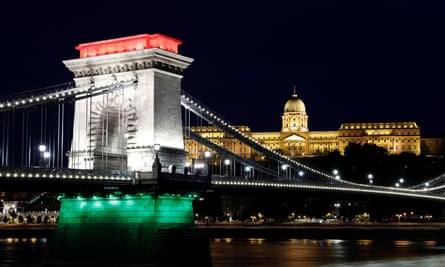
Budapest’s Chain Bridge.

Budapest’s Chain Bridge. Photograph: Bernadett Szabó/ReutersAdvertisement

Most of Flatio’s properties are in Prague and Budapest, but it also offers rentals in other central European cities and plans to extend to 100 new cities in the next 10 years. The company is aimed at remote workers and tourists looking to stay in cities for months rather than weeks, and offers everything from furnished studios to six-bedroom apartments, starting at £400 per month. Flatio charges between 4-15% of the final booking fee, based on the length of stay.

SpotAHome

Launched in 2014, SpotAHome is an online rental platform with flats in a cities across Europe, from Lisbon and Barcelona to Dublin and London. Examples include this contemporary one-bedroom apartment in Lisbon from £631 a month. The minimum stay is 30 days and fees start from around £55.

DayZero

New start-up DayZero is a different concept. It connects European craftsmen with travellers who want to try out dream jobs, be it to learn a new skill to start a business or simply experience working abroad. If you wanted to open a pizza van, for example, you’d go to DayZero, who would introduce you to owners of a family-run, classic pizzeria in Sicily. You’d pay a fee then go and learn how to make proper Italian pizza by working and shadowing your hosts for a month in Sicily. The idea is that guests get to experience living overseas while learning a new skill, and local businesses are given a financial boost. All 14 hosts are based in Hungary and Italy, but the company plans to add the UK, Ireland and other countries to its inventory post-pandemic. Experiences cost from £460 for a month (not including flights and accommodation) plus fees, which are 15% of the total cost. The first trips are due to take place in 2021.

Indie Campers

indie campers

 Photograph: Tiago Pinheira/Indie Campers

Over the summer, van hire company Indie Campers saw a 225% rise in bookings of over four weeks and a 40% increase in people who stated that they were travelling on a solo trip. As a result, it is planning to launch a new service aimed at nomadic workers this autumn. Customers will be able to take out a monthly or annual subscription to a campervan at lower daily rates than current prices. The company hires vans across Europe and offers portable wifi as an add-on.

Source: https://www.theguardian.com/travel/2020/sep/25/the-rise-of-the-half-tourist-who-combines-work-with-a-change-of-scene

Hotel also needs to be a destination

23/09/2020

Digital is the new normal and the future of hospitality

Flora Keresztely

The past few months have been a strange time in the hospitality industry. We have seen a lot of hotels closing. Some haven’t opened up since. But the ones that did are doing a lot to keep up with the new normal. They are looking for more digital solutions as we are all experiencing physical distancing, restrictions and the slow disappearance of high-touch places from hospitality. The physical front desk is starting to transform into more digital ways.

The older generations are not so keen on leaving their homes at the moment, they need a bit more security from the market. The way I see it, there is also a certain age group who has started to travel already, and that is the people between ages 20-50.  So as a hotelier, you need to see how this age group travels and what their needs and expectations are. Most of these people already live in a digital age and use their phone a lot during the day. They want to be connected, but they are not looking for a handshake or another type of physical experience; their preferred connection is digital. Quick, smooth and done already.

Anything digital, especially prior to arrival such as an email or online check-in is the way to make guest’s stay smoother and the time spent doing unnecessary things less.

How do hotels cope?

We see huge differences where we work all over the world. In Central-Eastern Europe, very often the solutions we provide are perceived as too much of a change, too innovative. While hoteliers there are always eager to learn, they are only now starting to see value in more digital solutions.

On the other hand in Western Europe and the Middle East hoteliers are very engaged, already using online check-in and other software-based hotel technologies.Advertisement

We see a different mindset to how they perceive the current situation because surely things won’t stay the way they were before. The sooner a hotelier realizes this the better, you don’t need huge changes. Start observing your customers – what do they want? Is social media important to your brand? What makes their stay at your place unforgettable?

Travel technology is exponentially advancing, as travellers change their expectations.

I’m always pro-digital solutions because you minimize human labour, costs, and especially these days it’s important to function properly with a reduced number of staff. 

Unfortunately, I still see hotels thinking that everything will go back to normal, which, even without the pandemic, is just not true.

Will the industry ever return to its previous state?

The capital cities are going to continue to experience fewer travellers until business travel and large groups return. It’s hard to maximize occupancy without these, and of course, current travel restrictions and the rise of Zoom is not helping.

We are really looking forward to times when overseas and Asian-European travel will be on the same level as it used to be, but that’s unlikely any time soon.

What I can advise hotels in the meantime, is to start standing out from the competition.

It’s mostly domestic travel, so find those unique characteristics and selling points of your property that will be more attractive than similar hotels at your location.

Also, engage with your community; if your occupancy is low, maybe you can rent out your banquet hall? Invite local companies for team building activities, use your services for catering, or really try anything that can help engage with your locals.

What change will come fastest?

I already see a lot of new concept hotels popping up. I think they are becoming really popular because the modern day traveller prefers to stay somewhere just a bit more special than the classical hotel with a ‘nice room & nice breakfast’. Nice does not cut it anymore. It’s the same with a concierge as a hotel employee; they are not there anymore and that service has become digital.

I talked about it a bit before, but hoteliers need to see their property as a destination, even though that’s usually associated with the country or region.

Now your hotel also needs to be a destination. If you are unique, people will want to stay with you, and I see more and more hoteliers are understanding this.

A lot of our partners did remodelling lately. From rebranding your image to redefining the type of customer you’d like to attract, you can do all sorts of things to make your visitors stay memorable.

A great example of a unique property that took the most out of this situation is the Le Bijou Hotel in Switzerland. They offered a ‘quarantine stay’ for 14 days, fully catered, accompanied by medical staff who could do regular check-ups if needed. It’s a new concept which probably will not continue after the pandemic, but it’s surely a good way to go about the current situation.

Of course, changing anything and keeping up is challenging because of the rising competition from Airbnb, but think about what Airbnb does well.

Airbnb is popular for a reason. I believe that there is the same amount of interaction between the host and the guest, but it’s not done by a handshake. It’s fast and digital. Therefore, we can skip the awkward and unnecessary smiling and small-talk. 

What type of product or innovation should be first?

Honestly, anything guest-facing. A digital solution that goes beyond and connects with the guest during the entire guest journey (obviously with an opt-out option).

You might prefer an app or text messaging; there is no one way to go about it as long as you find a new digital way to approach the customer.

However, it’s important to connect more with the guest than just at the point of reservation and once they arrive at the hotel.

With a messaging system you can also easily offer them a better stay, starting from a taxi transfer, to anything really; include as many other businesses and third-party vendors as possible.

Digital is the new normal and the reception or concierge services as we know them now might entirely disappear within 10 years.

About the author

Annika Ülem is the co-gounder of GuestJoy.

Source: https://insights.ehotelier.com/insights/2020/09/23/digital-is-the-new-normal-and-the-future-of-hospitality/?utm_source=Newsletter&utm_campaign=083d997b60-Daily_Newsletter&utm_medium=email&utm_term=0_e17a7bf7c4-083d997b60-327206962&goal=0_e17a7bf7c4-083d997b60-327206962&mc_cid=083d997b60&mc_eid=fc1a397e4d

Blockchain and Tourism Industry

Blockchain technology is poised to revolutionize many parts of our daily life, even the way we travel. We’re going to analyze what it is and the impact it can have on the tourism industry.

blockchain technology and tourism

Over the past few years, blockchain’s appearance has caused fervor across a plethora of interest due to its potential to drastically transform the way we store and use data and other information sources. This technology promises to improve transparency and security in transactions, leading the tourism industry to experiment with it. Some developments prove to be quite interesting, and we’ll go into further detail about blockchain’s applications in travel and tourism.  

But first, what is blockchain anyway?

Blockchain is a technology that publicly stores all the transactions that a particular network produces. Each register gets encrypted, and they get grouped into blocks that form a chain, thus leading to the blockchain moniker.

Blockchain technology’s primary characteristic is that the data is decentralized, meaning that they get distributed throughout the different nodes or computers that are part of the network. Each one of them has a copy of all the compiled information. Once a block or a register gets added, all blockchain members have to confirm it to get added in the copy that each part of the blockchain stores. This process ensures that the blockchain’s data is secure, traceable, unchangeable, and transparent.

This video gives you a straightforward explanation of how blockchain works:

But how does blockchain technology ensure such a high level of security? 

Most of the time, we use a centralized model, or that all our information on the Internet gets stored in one place such as Google, Facebook, or WhatsApp. In contrast, blockchain decentralizes all this information. As we just mentioned, they get stored in different nodes all over the Internet, to guarantee the authenticity of that information in a much more reliable way. 

Three advantages of blockchain technology  

By its nature, blockchain offers a series of advantages or characteristics that apply to any industry, including tourism and tech. That’s why a MarketWatch study projected annual growth in its use of 51% in different markets.

1. Data security

The data inside blockchain gets decentralized through the nodes that make up blockchain’s ledge; since there is no single failure point, with the data’s safety assured.

2. Immutability

The algorithms that blockchain uses are designed to avoid modifications in the blocks, thanks to a chain of trust that guarantees that the data stored within the blockchain has not undergone any change.

3. Decentralization

The decentralization in blockchain gets produced because no entity has complete control over the processing of information; instead, it gets distributed throughout the various nodes that form the blockchain.

Applications of blockchain

Blockchain has served as the basis for other technology or applications, and some of them could be useful for the tourism industry. Here are some examples:

1. Smart Contracts

Smart Contracts are contracts that get handled using blockchain technology, allowing for these processes to cut out the middlemen (such as notaries, banks, or other entities) and lower costs and reduce processing times.

2. A single digital ID

There is a lot of talk about projects based on digital identification like the Alastria project that the leading companies listed on Spain’s IBEX 35 stock exchange are spearheading. This system allows for tourism operations to simplify the tasks they need to complete and have all the available information about an individual in one place.

3. Cryptocurrency

Cryptocurrency consists of virtual coins that can get exchanged as if it were any traditional currency. The difference is that they are out of the control of governments and financial institutions. If an exchange gets conducted, it will be registered in the blockchain network entirely transparently.

Blockchain in the tourism industry

Tourism and blockchain have the potential to become a powerful combination as the technology can bring safety and transparency to several critical touchpoints. In the case of a travel agency booking flights and hotels for a customer, it has to send the information to the different firms. Blockchain could make this operation more secure and transparent since the responsibility spreads throughout the whole network. The same will happen with foreign transactions, increasing the level of trust among all involved parties.

Possible blockchain applications in the tourism industry

Given all of blockchain technology’s characteristics and possibilities, some experts are pointing towards possible uses within the tourism industry. Here are some of the most interesting:

Easy, safe, and traceable payments

When it comes to payments, the main advantage to point out is that payments with cryptocurrency will be much more secure and traceable. As we previously mentioned, all transactions carried out on the blockchain remain registered in the chain and cannot get modified. Not only that, as it’s a decentralized system, but there also won’t be any intermediaries that can intervene or delay payment.

As such, we would no longer need to exchange currency when we travel to another country and simultaneously be subject to the trustworthiness or volatility of these foreign exchange operations. That’s why making payments using the blockchain can make a relevant difference when it comes to overseas transactions. In some cases, a process can experience a delay of more than a week or get canceled during that period with all the inconveniences that this causes.

Hotel or Transportation Coordination and Management

Decentralized management systems could also result in significant savings for large firms as this could let them get rid of the middlemen. By that same token, information flows securely while being accessible at all times, reducing management times and providing universal access to information.

Business ratings

It’s increasingly common that we look at forums and read user reviews when we travel; however, we cannot always guarantee who wrote them or their accuracy. With blockchain, all the information that shows up in the network is public, dependable, and secure, achieving better transparency and increasing consumer trust.  

Baggage management

Blockchain could become very useful to track our baggage’s location once we say goodbye to it at the check-in counter. It changes hands throughout the trip, just like we do. It’s possible, with the help of technology like blockchain, to track between companies and know where our suitcase is at all times.

Rewards systems

Could we be talking about the end of the loyalty cards? Many travel firms create loyalty programs for their customers with the aim of turning them into repeat customers. Blockchain would facilitate these processes and allow customers to check their points and, for example, exchange them for the cryptocurrency.

Three real-life examples of blockchain in tourism

1. Winding Tree

This company is developing a decentralized trip reservation platform. Winding Tree seeks to eliminate the external middlemen with the help of blockchain technology and significantly reduce the price up to 20%.

2. ShoCard and SITA

ShoCard and SITA have proposed revolutionizing the travel industry through identity management. While the project is currently in the early stages, the hope is that the platform eases the identification of individuals in hotels or airport checkpoints.

3. Trippki

This project aims to create a loyalty program using blockchain. Trippki lets customers and companies in the tourism industry get directly in contact with each other. They assign customers tokens for staying, for example, in a specific hotel and they get registered in the blockchain, never expiring and redeemable at any time.  

The challenges left to tackle

Blockchain technology is still in the early stages of its life. While there’s consensus about its potential, it is always challenging to know where it can get to and how it will impact industries like tourism.  

I think that there are two primary challenges in this realm. The first is personal identification. That’s because technology, by its nature, could prove to be a significant obstacle, especially when personal data comes into the picture. That’s why we’re increasing regulations over personal information on the Internet through specific legislation like GDPR in the EU or the CCPA and the growing use of permission marketing. Blockchain’s future in marketing lies in granting more protection to users.

Standardization could also prove to be a substantial barrier. Although blockchain serves as the base technology, every company, organization, or collective can create its network and include its algorithms (just like with cryptocurrencies), making communication between different systems difficult.

The swift implementation of this technology in a plethora of industries and changing behavior from consumers increasing their familiarity with these concepts makes us aware that it’ll be a more recurring concept in our lives in the future as it adapts to evolving user needs and challenges. That’s the way to enjoying a more secure, trustworthy way to travel. 

Source: https://www.wearemarketing.com/blog/what-we-can-expect-from-blockchain-in-the-tourism-industry.html